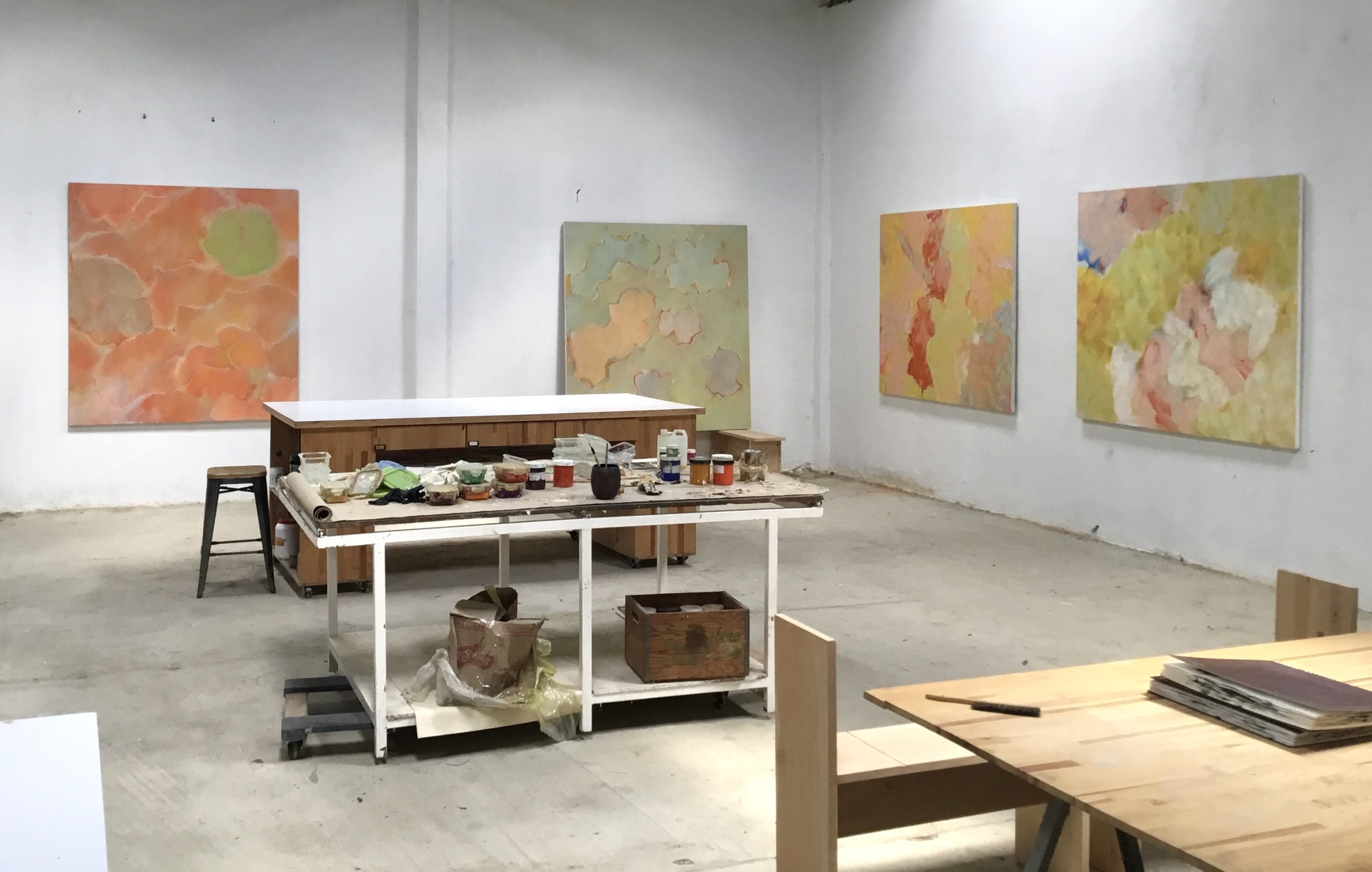
The last four people sharing lock-down with us here at ArteSumapaz have left, and I now have both an exhibition space (elGranero) and the massive studio. Several years ago, I packed up all of my work that had been in the upstate New York studio, and shipped them to Bogota. I realized recently that I really needed to unpack these paintings that had been wrapped in plastic and cardboard – some of the earlier works were suffering from the direct contact with the cardboard – so I decided to use this opportunity of space and tranquility to unpack, and to mount a personal retrospective of my work.
In march 2019, I spent the month at Studio Kura in Itoshima, Japan, in an artists residency. During that month, I made two large pieces using ink on hemp paper, collaging the drawing together as I worked. During the exhibition, I was asked to make some comments, which are below.
So in the history of art, there’s two major approaches to the figure. And the first of which is what you see in both a lot of Western art and Eastern art in which the figure is this hero; the Buddha; the Christ; frequently, where you have this central figure from which all the world is emanating. The figure might be ascending, or descending, or just holding space. For many years I’ve played with that idea, but over time, I’ve become interested in other approaches to the figure. And the ways that figures interact with each other.
How many different ways can two or more figures interact? The Virgin Mary holds the baby; two lovers; a fight; many , many more. And these pieces i like to imagine figures interacting in various ways. In one moment, they might be doing one thing, but at any given moment, i might change my mind! Maybe the figure that were fighting, are now kissing, or hugging! This is what goes on inside the painting, where the painting is talking about itself. And then there’s me, and our relationship to the painting and what its doing, and that can be a very different story.
I think when I’m sitting in my studio all alone, quietly thinking about what matters to me, I think the thing that is most important to me is the idea of an embrace. A hug: whether it’s a mother, a lover, or even ourself, giving ourselves that. I think what I’d like most from the work that I do is that it embraces you, the viewer, so that hopefully when you leave this space, you feel you’ve been given love.
If there has been any one famous person I would have liked to have had over for dinner, it would have been the art critic John Berger. Throughout his books you get the sense that his love of art was that of a practitioner, and it flowed over into his love of life and friends. In one of his essays, I recently found a few paragraphs that express perfectly my own feelings or aspirations about my own art.
Writing of Rembrandt, Berger wrote, “On canvas after canvas he gave to a part of a body or to parts of bodies a special power of narration. The painting then speaks with several voices – like a story being told by different people from different points of view. Yet these ‘points of view’ can only exist in a corporeal space which is incompatible with territorial or architectural space. Corporeal space is continually changing its measures and focal centers, according to circumstances. It measures by waves, not metres. Hence its necessary dislocations of ‘real’ space.”
(…) “If they reveal an ‘inner-ness’ it is that of the body, what lovers try to reach by caressing and by intercourse. In this context the last word takes on both a more literal and more poetic meaning. Coursing between.”
(…)”For Rembrandt, the embrace was perhaps synonymous with the act of painting, and both were just this side of prayer.”
The other day, there was an announcement in the news that the oldest figurative paintings, cave paintings in Borneo, have been identified as being over 40,000 years old. We´ve been mixing color with some sort of medium and applying it to surfaces for a long time.
Someone once said something like this:
“Leonardo da Vinci was a great artist. Titian was a great painter.
Ingres was a great artist. Delacroix was a great painter.”
And the list continued right up through Rauschenberg and Johns.
What does that mean? What is the difference between a great artist and a great painter? It was a wonderful proposition, and no doubt was intended to be polemical. Maybe there isn´t really a correct answer, but somehow in debating we come to see painting and its position in art differently.
Paul Delaroche, a French painter has often been quoted as saying ‘from today, painting is dead‘. He said that after he saw one of the new daguerreotype photographs. And certainly, photography stripped painting of its mimetic purpose. Other people have occasionally repeated some version of that phrase; and then, whether it’s simply zeitgeist or a conspiracy, there seem to be a whole new spate of shows in Chelsea galleries featuring really strong painting. We’ve been at this for a long time.
Correggio, that wonderful Italian renaissance painter who was so gifted, there can be no other conclusion but that he was brought to our planet by aliens, has often been quoted, probably apocryphally, as saying, “Anch’io sono pittore” (I too am a painter!) upon seeing some works by Raphael. Even if he didn’t actually say it, the fact that someone would fabricate the sentiment is telling; for one great painter to recognize the familial connection with another within their shared media.
I’ve been gallery hopping here in Bogotá for over three years now, and I rarely see a lot of painting. (Jaime Franco and Luis Roldan have been wonderful exceptions.) There tends to be a lot more what you might call conceptual art here in Colombia. Colombia is a very different place than the US; and you might say that the differences are fundamental, going right down into the soul of the place. If a street vendor gets on the bus and says “good morning,” everyone on the bus replies, “good morning.” It’s the polite thing to do. You wouldn’t do that in New York City. The biggest difference I’ve felt in the galleries and open studios is that people have narratives about their art that they like to share. The idea of the art speaking for itself doesn’t appear to be that popular. You’ll see little narratives typed up in US galleries, too, but here it’s at another level.
Sometimes it’s great to hear the story behind a show – and I admit, I’ve gained from it. At other times, it seems gratuitous. But still, there is more often than not a strong feeling that the concept behind the art is critical. And there’s a great deal of what you’d call “conceptual art” here. And so it often comes up in conversation; what is it about the difference between painting and conceptual art?
It reminds me of the whole disegno/colore paragon that was popular during Correggio and Raphael’s time. Maybe, just maybe, the dialectic is off kilter. Perhaps there is a pattern between both of those oppositions; disegno/colore and conceptual/painting. For one, it’s obvious that a painting can often be quite conceptual, just as a work emphasizing great drawing can be glowing with color. Perhaps, the difference in both oppositions is the sense of planning versus process.
It was said that Ingres would paint his works in grisaille, and then overlay color. Obviously, that’s a pretty well-planned approach to making a painting. As opposed to Delacroix’s laying down brushstrokes, and “discovering” his image. It makes me think of architecture, in which someone wouldn’t think of constructing a house without very specific plans.
Coming from the tradition of the New York school of painting, I’ve always been submersed in the approach of working through the medium – the voice of the medium, as opposed to imposing ideas onto the medium. I like the idea of discovering the image; being surprised by it. In this, there is a connection to surrealism – the cadavre exquis. Chris Martin wrote , “We are trying to paint what we have never seen before.”
I have a feeling that “painters” have a lot to learn from the world of conceptual art – and some painters have shown that they’ve taken the lessons to heart. And that the obverse is true, too. The controversy really is only as valuable as it adds to our collective thinking.
(For updates, please visit us at www.arteSumapaz.org)
We couldn’t drive up the road – it was blocked by a portone, one of the massive gates that Colombians often have at the entrance of their properties. But I skirted around a pillar and made my way up the driveway, past groves of bamboo or guadua, and massive stones completely surfaced in lichen. At the top of the road rested a clay-tile roofed, one-story casa with a porch wrapping all the way around the side and front. There on the walls were a half-dozen posters of art: Matisse, Renoir, Dali, Picasso, Miro, and other classic modernists. The ink of the reproductions had all faded in the sunlight, leaving only the blue and black inks. Why were there art posters on a farmhouse tucked away in the Andes?
View of Hacienda Australia in the clouds
That was only one of many aspects of this magical place that have become a part of my humongous audacious dream; to establish an alternative school of art, residencies, and perhaps even a sustainable community in a former coffee plantation about a 100km drive from Bogotá.
When I was 17, I was studying German in my local high school. One day, I visited the library at the Goethe Institute in Atlanta, and came upon a two-volume edition of Paul Klee´s Pedagogical Notebook. My German was still pretty rudimentary, but I could make out was that Klee was primarily saying, “hey, look at nature; not just at the surface, but deep down into the system and structure – whether it is a flower, a human body, or even an entire eco-system.” The systems-based approach to understanding the world, and by extension, art, really resonated with me – it struck a nerve or a chord, so to speak, and was even a core element of the book that I went on to write about social media marketing.
Klee had developed his notebooks as a record of his pedagogy at the Bauhaus, which had set up shop as an alternative art school in Germany in 1919. When the Nazis rose to power, the Bauhaus was forced to close with many of the teachers migrating to other countries. One professor, Josef Albers, along with his wife Annie were invited to lead the art program at a new experimental college, Black Mountain College, in the mountains of North Carolina. While the teaching methodologies that Josef Albers espoused have often been criticized for their pedagogical rigidity, Albers played a key role in an institution that, which while it only lasted 25 years was one of the most influential in the way art is taught in the US to this day.
View from above the house looking towards Chinauta
Black Mountain College was established in 1933 by three professors who had lost their own jobs for refusing to take loyalty oaths. One of the key influences in the founder’s philosophy was that of American philosopher John Dewey. Dewey was also tapped by Albert Barnes in the formation of his school, the Barnes Foundation, in Merion Pennsylvania. My own mentor and professor of painting at SUNY Purchase, Nicholas Marsicano, had himself been a Barnes Foundation student. Barnes was notoriously opposed to the snobbishness of the Philadelphia elite, which included the Pennsylvania Academy of Art; thus, when Marsicano and fellow student Ralston Crawford wanted to be accepted into the Barnes academy, they had to meticulously avoid any mention of their experience in Philadelphia and claim to be the sons of poor coal miners.
Marsicano was a truly great influence in my artistic life; in his teaching, Marsicano believed that a teacher should leave their own artistic prejudices at the door, and help the student solve their problems through their way of thinking. In one conversation, while looking at a painting, he asked, “do you know the difference between a monster and a demon? Because what you have here is a monster!” I think that for many of us students, that sort of talk lit a fire under our minds, and got us to think more deeply about painting.
I was so fortunate to have a found a great teacher; we are all lucky if we find one such person in our formative years. But I was doubly lucky, because before I worked with Marsicano, I had the good fortune to encounter the sculptor and teacher, Jim McDermid. McDermid, incidentally, was a graduate of Cranbrook Academy, which has been called “America’s Bauhaus.” I recall one day working away on a sculpture, carefully carving out shapes out of rolled-out clay, while tossing the scraps in a heap. I heard McDermid exclaim, “wow, that’s beautiful!” But when I looked up, it was the scrap heap he was admiring! And admiring was just the right word – McDermid taught me to look at the world in admiration; perhaps let the things that aren’t so wonderful pass. He exemplified for me the words of Van Gogh, “Admire, admire, admire!”
Exploring the finca on horseback
Really, I came of age, artistically, in an environment which was awash in the thinking of the New York School. The current New York art scene was moving in another direction – that of more conceptually rooted art – but my influences were those which came more out of a process-based art. The great playwright August Wilson was once asked how he made his characters have a voice, and his response was something to the effect of “allowing them to have a voice.” This is the very type of thing that was implicit the New York School way of thinking.
At SUNY Purchase, the flagship school of the arts in the New York public university system, I also met musicians, dancers, photographers, and writers. It was amongst the actors that I came across a whole other approach to art, that was based in the teachings of Stanislavski, Stella Adler, and others. For example, while working on a play, the director might yell out, “inside,” meaning the actor should work from a place inside their body; and then “outside” for the actor to feel that they were indeed outside of their skin. To me, this was revelatory, and antithetical to the seemingly drier way of thinking back in the visual arts building. Later, when I was teaching drawing at the Woodstock School of Art, I used some of those theatre techniques in my own teaching.
One day at college, while in a fit of desperation, I was in the library thumbing through books, I came across a little book about Zen Buddhism that retold some of the teachings of Rinzai. They were fundamentally about notions that the listener should stop the thinking process, be – experience reality with all of their being. This resonated with me in a way that the Klee notebooks had earlier; I felt that painting could be about something that was outside the bounds of thinking and words. That lead to one of my painting teachers, the very kind Bob Berlind, to write in my evaluation, “Ric fails to engage in critical discourse.”
Coincidentally, when my then girlfriend, Jen Williams Dragon (now with her own audacious dream, Cross Contemporary in Saugerties, NY) and I later moved up to the Catskills, there was a newly-established Zen monastery being developed in Mt Tremper. Abott Daido Loori had found the property, a former Lutheran summer camp, and established the monastery. Over the years I studied there a bit, and even more often, encountered Loori at the local diner. While I was admittedly a poor student of Zen, I felt it had a tremendous impact on my thinking – and I continue to be a poor student of Zen even now.
View of the front porch of the farmhouse
One of the big things I got out of eastern ways of thinking was an approach to looking that isn’t often talked about in European-based art; that of becoming something. We tend to look at things more as objects sitting across the room, or as a landscape. But in working to really feel something with your whole body – a landscape, another person, or even a painting – we can have experiences of the thing that could be a totally different way of looking.
The Zen monastery in the Catskills wasn´t the only such place that figured in my life. During my adolescence, and oddly enough in Conyers, Georgia, there had been a Cistercian (Benedictine order) monastery founded in the 1940s. For a short while, I had had a job in the bonsai greenhouse. At the Holy Spirit, I met brother Aelred, who secretly shared woodcut printing, and secretly, transcendental meditation.
Both of those monasteries come to mind as I think about my own project; they were both established in a grass-roots manner – by individuals who got the “bee in their bonnet” and made it happen. Perhaps it’s the allure of creating community of like-minded people, and creating sacred spaces where people can do things that they hadn´t imagined. After all, in thinking about Black Mountain College, I’m not convinced it was the pedagogy – but more the creating of community, and moving thinking outside and beyond the way we think about things every day.
I’ve met an enormous community of young artists and musicians here in Colombia; they’ve had a different education and seem to be interested in some of these other approaches to artistic thinking. The idea of sharing this, and in the process discovering what they, and other artists have to bring to the table, is exhilarating. And in Great Britain, Mexico, the US, and other places, other new forms of alternative arts education are emerging. My main objective is to create that; an alternative arts school.
When I, and others, start envisioning what this could be, other things surface: community; sustainability; working with indigenous peoples; and more. But all of this is way beyond the capabilities of any individual. Thus, the beautiful challenge is to bring together others who want to participate in the creation of an arts-based community project here in Colombia.
There are many, many challenges facing this project. The first is acquiring the property. The next, if not at the same time, is creating the coalition of people who want to participate and lead in the various aspects of the project.
Identify four to five individuals who can bring the financial resources to help acquire the property (goal: to acquire the property by the end of 2019).
Share this with anyone you think might be interested
Feel free to have a conversation – let me know and we can start a call
Here in Bogotá, we are planning a series of presentations over the next year in the homes of friends. If you’re interested in hosting such an event, please reach out.
Transcript of a talk given by Nicholas Marsicano to his painting seminar at SUNY Purchase, circa 1984.
The Dada act appears to be by, upon a situation. The man who put the moustache on the Mona Lisa did not put it upon Leonard da Vinci; he put it upon a lousy painting that they made so much of, romanticized; all false values in terms of what art really is. Leonardo da Vinci has a little painting about this big sitting up like that over the Mona Lisa on the side; one of his masterpieces of painting; his masterpieces – the Annunciation – everybody comes gawking at the Mona Lisa because all of this fiddling that takes place around it. These are some of the things you come to understand.
In terms of service: the nature the art serves society or makes the world better to look at or something like that; this business of Utopia, or humanism, it’s going to do something to make a better human being – or is going to propagandize for some situation. I’m afraid, yes, it can do that. On the other hand, it can be the worst enemy to any of these dogmas. The church or dogmas, the government or dogmas, society, or social injustices.
I can’t quite say the man who was most religious painted the most religious painting. In this case it was just the opposite. The non-believer who believed rather than the artist for the dogma. It’s true at times. Art has been subject to the church. Art has been subject to the government. Art has been subject to society and each and every one of us in some ways are affected by this opinion and by the circumstances. And some ways, sometimes we appear to make a concession to what the world wants of you, and yet, you are committed to the truth – the inner truth of one’s self. Even though the external truths is demanded of you, is something else, and you can do it – perform it. But in the end, you know you are being untrue to yourself. When it comes to painting, I think that’s the one thing you have to know is to be true to yourself. In that sense, it is an individual singular art. There’s only one man who paints or one person who paints, I should say. There’s not many, many people.
And it is possible art flourishes best when we come into contact with each other. In other words, when we have acquired respect for other painters like yourself. And you can look at their paintings and their art and it may be different from – appear to be different from what you’re doing – and to be able to say, “Jesus, that’s nice, I like that!” In other words, the generosity of appreciation and understanding is all we want. To hope that you’re going to get it from anything other than a painter and even then, it’s questionable, is impossible. They will say things; how wonderful you are and all that sort of business. But in the end, I think the respect painters have for each other, when that is possible, is the most important thing to any painter. Is there one person who understands me? Poor Van Gogh! If he would have gotten that, he wouldn’t have needed to have blown his brains out. They can say all they want about the guy being nuts, but that’s the thing that kicked-off the final tragedy of his life.
And he wanted it – and wanted it so badly and he needed it. It is an art of aloneness. But the one thing is, you cannot be alone. You’re only alone in the process and the act of painting and doing your own painting. After that, you want at least one person to say, “Jesus, that’s good, nice!” and to tap you on your shoulder. This also, you must be able to give. I find amongst students, the only reason why most of you are not doing the best work and justice to yourself is your inability to give it to somebody else. Because when you give it, it is you who are giving it. It’s almost like saying it’s your dream – and you are created. Perhaps and understanding for that painting that that other person who did the paintings, might know in a different way, perhaps, that the way you know. And that reassurance is all that is necessary and so therefore, in this class, I do hope and expect to establish some exchange. Any person’s accomplishments or student’s accomplishments should and must be your accomplishment. If they can do it, you should never feel you can’t do it, too. And the fact that they have done it you take your hat off and “thank you” – as if to say, “well, I don’t have to do it; It’s been done for me and I’ve done it.” Then you can go and do what you want to do. OK?
But that lack of generosity is what perhaps is one of the greatest limitations you impose upon yourself. It’s alright to say, well, I’ll only go look at Rembrandt. Yes, it’s safe, but even then there are bad Rembrandts. Even then, there’s no saying what you see, whether you see the right thing or not is the right thing. That learning to see is what it’s all about.
I don’t necessarily encourage the habit [referring to a student with a studio off-campus] or the idea of that kind of situation at a certain point – and if you’re good, then it’s even more important why you should be here that others should be able to see what you’re doing. It’s part of your responsibility to give as well as to take.
I think the poet or writer is more capable of that kind of isolation because he can go down to the mailbox and the world comes to him. But when it comes to painting, you got to be able to see and see the real thing. I know you can tell me you got all the books and all the reproductions and all that sort of business, and I know that Malraux spoke about the “Voice of Silence” or something like that. That business of an art that comes from a reproduction. It’s not the same thing as seeing a painting – as seeing the scale of it confronting it. All right – that’s my answer to that. My only hope is you don’t encourage it any more than necessary in terms of isolating yourself. Look, they’re nice people, and nobody’s going to bite you. And if they do, you’ve got to learn to bite back. Otherwise, you’ve not going to learn how to survive. I mean, if you’re so precious you’ve got to be protected, that individuality, it’s hopeless. You might as well give up the ghost and go buy yourself a new one at the five and ten cent store if necessary.
What I mean by that is you can’t be so protective of your art and yourself. Because the world is hostile. They don’t like the fact that you paint. And they’re going to pick away at you in every shape and form that they can. When you told your mother or your father that you wanted to be an artist – that’s the last thing in the world they wanted to hear. And God knows they should be the most sympathetic. You’re not desirable citizens. You are the devil, that’s all there is to it. And you’re the snake in the grass in the garden of Eden. Well, face it, that’s the artist.
And especially today I think it’s more hostile that it has been for a long time, this whole situation. There have been periods certainly when the artists perhaps were in command of the world of art, but today I think you’re at the mercy of gallery dealers, critics, museum directors, and everything else.
The art critic Jerry Saltz wrote an article earlier this year about his having been an artist when he was younger – and his decision to no longer be an artist. I´ve found myself discussing the article with friends, now and then, and see references to it pop up again and again on Twitter. I suppose you´d say the piece hit a collective nerve. Perhaps we artists are like the married, who when they encounter a single person, are hell-bent on making sure that the solo becomes a duo post haste. When we see one of our tribe has given into the relentless oppression of life; throw in the palette; we want to say, “be strong, hang in there!”
And why not? We need good critics – critics who are sensitive to the vagaries of the art life, as Saltz certainly does.
I didn’t have the ability and fortitude. That’s why I always look for it in others — root for it in others — even when the work is ugly or idiotic. I want every artist, good and bad, to clear away the demons that stopped me, feel empowered, and be able to make their own work so we can see the “real” them.
Wouldn’t it be wonderful if people in all walks of life had a deep rich background in the art – visual, literary, or otherwise? So, for me, it’s OK that Saltz went on to something else. Only, something doesn´t quite sit right with his piece. He asks at one point, “How deep is my lack of artistic character? Pretty deep, it turns out.” And the evidence for this?
Saltz´s critic-in-residence, his wife, Roberta Smith, said, “They’re generic. And impersonal. No one would know what these are about.”
Saltz himself goes on to say, “[Wilde] wrote that art that’s too obvious, that we ‘know too quickly,’ that is ‘too intelligible,’ fails. “The one thing not worth looking at is the obvious.’ This sort of art tells you everything in an instant and can only tell you the same thing forever. My work had the opposite problem. It was vague, arcane, and therefore obsolete. Only I could decipher it.” He continued, “my art might be able to produce flashes of beauty but couldn’t gain emotional traction; create depth, mystery; impart its secrets, ironies, drama, or cross the threshold of history. I was blinded by the rules I made.”
And maybe those works those portfolios of work that Saltz and Smith looked at were obvious. Maybe they stank to high heaven. But that still doesn´t mean that Saltz himself was a failure at art. That idea of someone having it or not just doesn’t square with what artist after artist – and mind you, artists that have come to be considered the definitions of success! – has said.
“To be an artist is not about making individual works. To be an artist is to do your work and let your work express the evolution of a vision. It’s a continuous process for which there is never any full, unqualified reward. You don’t get something done and say, ‘oh, that’s it.’ You get something done and it’s part of a living situation. It isn’t a matter of getting something done, and then getting a number of somethings done, and then making an exhibition and selling the somethings. That’s what happens outside the studio (…)” – Brice Marden, Cold Mountain
And this from Sally Mann:
“Art is seldom the result of true genius, rather it is the product of hard work and skills learned and tenaciously practiced by regular people.”
So, in the end, I´m not saying it´s either bad or good that Saltz’s life changed course and he’s a critic instead of an artist. I´ve got a good hunch he lives an artful life; and I sure appreciate what he puts out there. But the myth that some people “have it” and others don´t is dangerous. Perhaps that’s the fault of Wilde’s witticisms. Instead, I might point to Georg Buchner,
“What I demand in all things is life, the potentiality of existence, and that’s that; we need not then ask whether it be beautiful or ugly, the feeling that whatever’s been created possesses life outweighs these two and should be the sole criterion in matters of art.”
Being an artist can be challenging. A lot of life shit can get in the way; the need to make money, put bread on the table, gas in the tank, and such. And then there’s just the human penchant for distraction, which some of us have more than others. All sorts of people are afflicted with all sorts of different habits, norms, and mind tics.
Taking on a warrior mindset can help. By that, I don’t mean the violent side of warriorhood; but the determined, tactical, and strategic side. It will mean being ruthless about some things.
Once, an Asian conductor in one of Seiiji Ozawa’s master classes was going through a particularly emotional and difficult time. After some discussion, Ozawa said something to the effect of, Sometimes, you just need to be strong.
Warrior mode means you’re going to make some life decisions that put you in a better place for making art. The decision process of, “will this further me along in making art?” becomes a heuristic – a decision-making tool.
So what might it mean for the artist?
Setup life so that you have fewer needs and distractions. That’s challenging in US culture, today. And it’s only getting more so. In the 1940’s and 50’s, artists had apartments in New York City’s Union Square – Pollock was there, as well as Rothko and the DeKoonings. Rents were about $20-50 per month – which was a lot of money back then. But it’s not as much money as an apartment in Bushwick is today in today’s money. Back then, if you were tight on rent, you could throw a rent party, invite all your friends, and the small contributions would be enough to get you through. Today, that just wouldn’t work; the numbers are much higher.
Outside of the urban areas, transportation can be challenging; here, you need a car. And the second you need a car, you need gas, insurance, maintenance, not to mention the cost of a car. Where can you go where you wouldn’t need a car?
Really, watch the stuff you buy. Things need care and attention. Even if once a year you move it from this spot to another. If it feeds your mind, great – if not, reconsider.
Some organization
A lot of artists lack organizational skills; they relish the chaos. In warrior mode, you identify your big overall goal, and keep that in your mind’s eye as you encounter the various impediments to getting there. You adjust, and readjust, and keep moving closer.
Your tribe
Isolation is unhealthy. The use of isolation in prisons has been deemed cruel and inhumane. It’s in our DNA – our species needs the touch and feel and voices of others. If you’re in the middle of a conservative village, you might have family, and old friends nearby. But you also might not have people who “get you.” You need that being understood, perhaps more than anything. Not a lot – just some. Find the people who understand you to some extent, and stay in touch.
We need community. It doesn’t mean you have to hang out at a Cedar Tavern every night getting sloshed – often, even a “hello” on the sidewalk is nourishment enough for a day. Other times, yes, you’ll need those conversations.
If you’re not in a community, find one. Or make one.
Polishing the sword
If the artist lacks energy, or is ill, she can’t make art. You’ve got to take care of yourself. That means eating well and exercising. If you haven’t developed those habits, try them on for size, and keep a journal. It’s very likely you’ll find that your concentration and energy improves.
We love our art supplies. We go to art supply stores and drool, and buy new paper and sketchbooks, and paint. You are your most important art supply. Without you, none of that stuff is ever going to get made.
I’d almost forgotten how it came to be that I’ve been making these large collages of ink on mulberry paper. Edom Hernandez had gifted me a fairly large stack of the paper before he died. The ream sat in my studio unused for many years, occupying its own drawer in the flat files.
Edom had been a close friend. His antique store in the Catskill Mountains was filled with interesting objects that often reflected his own refined tastes and interests. I, myself, spent a portion of those years buying and selling antiques, so when we weren’t at an auction or at yard sales, we often chatted for hours, and babysat Edom’s shop.
There is nothing quite like having a lot of quality materials to use for art making. If the materials are too precious, it can be inhibiting, while having a robust supply can help you get in that state of mind where making mistakes and being ridiculous can happen – important states of mind for the artist. Sometimes we require plentitude in order to take chances.
The stack of paper, once I started using it, did allow me to make mistakes and ridiculousness. The result was a few decent drawings, and even more rejects. I then started playing with assembling the “mistakes” into new pieces; and before long, I’d started making these large ink collages.
The paper lends itself to collage; when watered-down glue is brushed on, it soaks in and helps the paper adhere to the underlying paper.
Right now, making large-scale paintings isn’t practical for me, so this is a nice way to work large, and to be thinking of the paintings to come. It’s gratifying.
Jen Dragon stopped by the other day, looked up at this piece, and said, “oh, a deposition.” Jen’s seen a lot of my work over the years, and is pretty in tune with my sensibilities. The scene of the deposition was a classic theme in the history of art; it’s the moment in which Christ is being taken down from the cross. It often shows Christ’s outstretched body being supported by a group of other figures, creating a sort of diagonal repose with the tension given by supporting hands and arms.
Jorge Jaramillo, a neighbor and acquaintance, died this past week. Jorge had been a dear friend to another friend of mine, and it reminded me of my friendship with Edom. “Dear friend” isn’t quite the word when two people have that special bond of good and frequent friendship – and it isn’t as common, perhaps, amongst men. So, perhaps, a deposition – an end to suffering that leads to the burial – is very much present.
These thoughts all weave in and out, not unlike a collage, too; old friends, dying, making art. Sometimes newer thoughts obscure older; still present and sometimes more powerful for their semi-obscurity.
We sapients do something called cultural ratcheting. It’s when we learn something from others, and build on it. Apparently, not even our closest primate cousins do this. Yes, they can use sticks as tools to draw ants from their mounds, or use rocks to break open some hard-shelled food, but they don’t go on to develop increasingly sophisticated tools. We do.
In fact, we can build off of one another’s knowledge to such a degree, that there is no end to the things that no individual is capable of building. The computer mouse is beyond any one of us. Creating the plastic shell, alone, requires a factory and a supply chain stretching around the world.
If I was born this morning, and from this day on endeavored to build a car from scratch, I would probably not get very close to my aim even after a lifetime. I might start with the notion of creating metal, and for that, I have a notion of gathering iron ore, creating a fire hot enough to extract the iron, and working it from there.
Our sum knowledge has built up century after century. The medicine taught at hospitals, engineering, physics, mathematics, literature; all built up over time. We stand on the backs of giants. It’s also grown, perhaps, at an exponential rate. It’s said that the sum of invention of the last century outpaced that of the entire history of the world combined.
In art, too, artists build upon the achievements of their predecessors. Walking about a museum, though, you might come to the conclusion that the path has not been as straight as an arrow. Instead, the Coptic Egyptians created some of the most elegant portraits in the history of humanity – then a thousand years later, while artful, the medieval artist created more crude portrayals.
The Asmat artists evolve slowly. Their woodcarvings, considered by some to be the penultimate achievements of carved wood art in the world, undergo small changes generation from generation. If these changes are the result of cultural ratcheting, it’s possible that an artist several centuries later will be building her parent’s work – but may not remember the meaning of the achievements.
Along this line of thinking, perhaps humans are hard-wired to labor away at aspects of their work without understanding why. Perhaps, like dreams of dreams of dreams, we don’t know the origins, but only deeply sense their proper place. Perhaps this our destiny – to never quite know why we know what we know.