Little Games

Jay Dragon, my child who continues to inspire me in so many ways, has been passionate about a sort of gamification that fascinates me. Most recently, they were posting 200 word mini games for an upcoming event. Inspired by these short narratives, I decided to write a few of my own based on ideas that have been floating around in my head. I’m not sure that what I’ve written qualifies as games in the same sense, but nevertheless, the ideas therein might be of use to someone.

All of these are games to play with yourself.

By the way, Jay has a Patreon site where they share some interesting thinking on the topic of games. 

And Yourself

Wake up in the morning. Before you look at your phone, – but go pee if needed – think about people in your life, and whisper, “thank you.” Start with your mother – and work from there – relatives, friends, mentors in your life. But when you’re done, say to yourself, “thank you.”

During the day go to the worst place with people. Maybe it’s the bus, or subway, or just some other place filled with people that may not be in the best mood. Look at each person, and imagine warmth in your chest for them. Imagine yourself giving that person a hug while still feeling the warmth. When you’re done, try to see your own reflection in a window or mirror, and imagine feeling the warmth in your chest, and giving yourself a hug.

At night, get into bed. Think about anyone who wasn’t nice to you either in the day or sometime in the past. With each, whisper, “I forgive you.” If you can’t think of anyone who’s been mean to you just think about fascists, and think “I forgive you.” Then, think about yourself, and say that, too: “I forgive you.”

Feeling colors

The next time you go to a concert, whether it’s amplified music or acoustic chamber music, hold out your hands with your palms upwards. You can close your eyes if you want. Feel the vibrations of the music on your fingers. It’s sometimes hard at first, but with a little practice, it gets easier.
Once you’re able to feel music vibrations on your fingers easily, try to feel it on the skin of your face. If you’re wearing a hat, you might want to take it off, as it’s possible the vibrations may travel down your hair follicles into your scalp, too.

Once you can feel music vibrations on your face, go outside, and feel the sunlight on your face. Now feel the colors you see on your face, too. And as you walk down the street, keep feeling the colors. Don’t just focus on the little colors – try to feel everything on your skin.

When you breathe in, breathe in the colors, and feel them mix up in your lungs. Now breathe out pure light. Imagine breathing out the pure light onto the people you see.

Anxiety the Dog

This is a game with your anxiety.

Turn your anxiety into a dog. A really ugly dog, with shit encrusted in its fur. This isn´t a nice dog, instead, it snarls at everyone, and chews its own butt incessantly. Put a golden lead on the ugly dog, and say “sit.” It might take a few times. Once the ugly dog sits, then try walking a few steps, and say “heel,” yanking on the lead if necessary. You can make those clicking sounds like the guy does on television, if needed. Just keep at it until the dog, despite chewing its butt, is bit better mannered.

Before taking a shower, imagine your anxiety is a crust of shit and mud covering your head, and all over your skin. As you shower, imagine the shit and mud slowly washing away, down the drain.

 

Making and not making art

The art critic Jerry Saltz wrote an article earlier this year about his having been an artist when he was younger – and his decision to no longer be an artist. I´ve found myself discussing the article with friends, now and then, and see references to it pop up again and again on Twitter. I suppose you´d say the piece hit a collective nerve. Perhaps we artists are like the married, who when they encounter a single person, are hell-bent on making sure that the solo becomes a duo post haste. When we see one of our tribe has given into the relentless oppression of life; throw in the palette; we want to say, “be strong, hang in there!”

And why not? We need good critics – critics who are sensitive to the vagaries of the art life, as Saltz certainly does.

I didn’t have the ability and fortitude. That’s why I always look for it in others — root for it in others — even when the work is ugly or idiotic. I want every artist, good and bad, to clear away the demons that stopped me, feel empowered, and be able to make their own work so we can see the “real” them.

Wouldn’t it be wonderful if people in all walks of life had a deep rich background in the art – visual, literary, or otherwise? So, for me, it’s OK that Saltz went on to something else. Only, something doesn´t quite sit right with his piece. He asks at one point, “How deep is my lack of artistic character? Pretty deep, it turns out.” And the evidence for this?

Saltz´s critic-in-residence, his wife, Roberta Smith, said, “They’re generic. And impersonal. No one would know what these are about.”

Saltz himself goes on to say, “[Wilde] wrote that art that’s too obvious, that we ‘know too quickly,’ that is ‘too intelligible,’ fails. “The one thing not worth looking at is the obvious.’ This sort of art tells you everything in an instant and can only tell you the same thing forever. My work had the opposite problem. It was vague, arcane, and therefore obsolete. Only I could decipher it.” He continued, “my art might be able to produce flashes of beauty but couldn’t gain emotional traction; create depth, mystery; impart its secrets, ironies, drama, or cross the threshold of history. I was blinded by the rules I made.”

And maybe those works those portfolios of work that Saltz and Smith looked at were obvious. Maybe they stank to high heaven. But that still doesn´t mean that Saltz himself was a failure at art. That idea of someone having it or not just doesn’t square with what artist after artist – and mind you, artists that have come to be considered the definitions of success! – has said.

“To be an artist is not about making individual works. To be an artist is to do your work and let your work express the evolution of a vision. It’s a continuous process for which there is never any full, unqualified reward. You don’t get something done and say, ‘oh, that’s it.’ You get something done and it’s part of a living situation. It isn’t a matter of getting something done, and then getting a number of somethings done, and then making an exhibition and selling the somethings. That’s what happens outside the studio (…)” – Brice Marden, Cold Mountain

And this from Sally Mann:

“Art is seldom the result of true genius, rather it is the product of hard work and skills learned and tenaciously practiced by regular people.”

So, in the end, I´m not saying it´s either bad or good that Saltz’s life changed course and he’s a critic instead of an artist. I´ve got a good hunch he lives an artful life; and I sure appreciate what he puts out there. But the myth that some people “have it” and others don´t is dangerous. Perhaps that’s the fault of Wilde’s witticisms. Instead, I might point to Georg Buchner,

“What I demand in all things is life, the potentiality of existence, and that’s that; we need not then ask whether it be beautiful or ugly, the feeling that whatever’s been created possesses life outweighs these two and should be the sole criterion in matters of art.”

Threads

This post first appeared in JP Loves Cotton, 12 Dec 2013

I’m not sure if she was insane, or simply eccentric. My friends who own the antique store didn’t seem alarmed at the lady holding up the camisole for inspection.  Her accent was heavy – perhaps eastern European. And maybe the item of clothing was not strictly a camisole , but a light cotton shirt.

I could see from five feet away that the garment was ornately embroidered – and that it was all handwork. The lady said, “My mother made it for me forty years ago, but my own daughter is too large to wear it.” The antique dealer’s wife, the one that ran the bakery and coffee shop out of the back of the store looked interested.

The antique dealer shook his head. He offered thirty dollars. Without skipping a beat, the woman said, “fifty.” At this point, I’m thinking to myself that even at thirty, it was a bit of money for an old shirt. But then, all of that hand work.

They finally settled on forty dollars and a breakfast.  I’ve had many a biscuit made in this shop, and I can tell you, the meal was worth it: also; all made by hand.

I can appreciate fine shirts as well as fine baked goods. At least the former can help me appear a bit thinner.

I own one bespoke shirt – a light blue cotton piece.  I bought the right to the shirt at a charity auction for a hundred bucks, and then was told that I had “scored,” that the shirt was a bargain at five hundred dollars.  After making an appointment, I had to travel to a brownstone building in the Flatiron district of Manhattan. I rang the bell, and was shown into a waiting area in a marble foyer, and then finally, to the penthouse fitting room. 

I chose the fabric, the cut, the collar style, and even the cuff style. Later, after receiving the actual shirt, I showed it to a custom shirt maker down the street. “Absurd,” he declared. “That much hand work is just absurd. It could all be done with a machine much more quickly – much less expensively.”

When I have a special meeting, I wear the shirt as a sort of talisman meant to bring me all of the good luck of the universe. The good mojo of the universe is all drawn to the hand stitching; the gods and muses all must realize that such a shirt deserves their good favors.

How we’ve lost touch with our clothes. Even while ironing a shirt, my mind plays over the various parts, but most particularly on the shirt yoke – that bridge of cloth over the back shoulders of the shirt.  I met a girl when I was a teenager who wouldn’t have anything to do with me. She was a good church-going girl, and she recited the line from Corinthians, “Be ye not unequally yoked together with unbelievers.” Ironing the yoke of my shirt reminds me of that rejection each and every time.

The creation of clothes must have been an incredible task in the days before the industrial revolution.  Combing cotton, the creation of thread and cloth, the tailoring of a shirt – how many hours went into any given piece of clothing?  Handwork was unremarkable in a time when everything was done by hand.  But how very valuable each and every piece of clothing must have been.

We live in a time where we are still privy to these little reminders – these bits of handmade clothing. We might hear a refrain from Summer Time – “the catfish are jumping, and the cotton is high,” and remember that cotton itself played a role in the American Civil War – that it was a key commodity in the world, and required great amounts of labor.

Today, when I went to the coffee shop, I noticed that the baker was wearing the shirt. This relic of a faraway trousseau was not only being worn, but appreciated – pointed out, felt between curious fingers. These cotton threads – not only between bits of cloth, but from another time and place.


Konnakol Resources

(update Sep 2020) Since last writing, Vidwan B R Somashekar Jois and his World Konnakol Academy have posted dozens of videos on their YouTube channel: Start here! 

(updated 8 May ´17) It’s not the purpose of this post to explain what Konnakol is, or how very valuable it can be in your music. I´m assuming you already understand that, and are seeking resources.  In my own quest to learn konnakol, I´ve found quite a few wonderful resources. I´ve made this compilation with gratitude to all of the musicians around the world who’ve made their teachings available. It’s really exciting to consider what the next generation of musicians are going to be doing with konnakol.

Free and Online

There is a vast library of wonderful konnakol videos on Youtube; many performances, as well as many instructional videos.

  • Shaale – A whole introductory course with Manjunath BC and Somashekar Jois  
  • Manjunath BC– Mostly advanced material, but has been one of my go-to inspirations 
  • Somashekar Jois – also mostly advanced, yet extremely inspirational material  
  • Henrik Andersen – Andersen gives away a mountain of material for free () and has also produced a couple of videos for sale on his website, mentioned below.
  • Asaf Sirkis  – a great series of introductory videos, along with a few more complex exercises.  
  • Bernhard Schimpelsberger – this amazing percussionist has a nice playlist of online lessons. Be sure to watch this performance to see the power  of konnakol in contemporary percussion.
  • Stefan Bulatovic – Gateway to Konnakol series
  • Konnakol Pro – Konnakol lessons with Andrey Danilov.

For a cost 

  • Henrik Andersen – in addition to all of the free material Andersen gives away on Youtube, his for-a-cost videos are a worthwhile expenditure. And unlike Schmidhofer´s, they´re digital downloads. 
  • John McLaughlin The Gateway to Rhythm – McLaughlin has been cited as one of the earliest and most ardent proponents of konnakol in the west. This DVD is fairly basic, and perhaps a nice thing as an intro to a musician. 
  • Solkattu Manual: An Introduction to the Rhythmic Language of South Indian Music – I´ve found this book a tad difficult to follow, but there were a whole set of free videos but they seem to no longer be available online.
  • The Art of Konnakol (Solkattu) by Trichy Sankaran: Rich book with CD – great explanations of mora, korvai, and koraippu. Email directly trichysankaran@gmail.com. – $60.00 (US) for U.S. and Canada customers and $70.00 for Europe and other countries.
    This is for 1 book with audio CD.
  • World Konnakkol Academy – Distance learning with B.R.Somashekar Jois
  • Christian Schmidhofer – Schmidhofer´s four DVD set is worth the price. He also has a nice way of teaching, methodically walking you through each exercise.  I’d really prefer to have the videos digitally, as my first DVD has already gotten damaged. (note, Christian passed away in 2016, and his videos are no longer available)

Other

  • Lisa Young – an Australian vocalist, Young wrote her PHD thesis on konnakol. She has created quite a few YouTube videos, as well as made her thesis freely available online. 
  • Loire Cotler – she´s on Youtube with a click-baitish titled piece, (why not, it´s gotten over 125k views!) – but she’s also out in the world doing some interesting performances. Loire, if you read this, come to Bogotá! 
  • Steve Smith – another great percussionist who has been introducing Konnakol to the world of drumming. Check out this wonderful workshop with Zakir Hussain at Carnegie Hall. Smith DID come to Bogotá, and shared a good day of konnakol.
  • Pascal Lovergne – workshops and videos
  • Arun Luthra’s Konnakol Jazz Project  – great combination, jazz and konnakol

Doubtless, I´ve missed something.  If you have a favorite resource, feel free to share.  I see that there is an IndieGogo campaign in the works for an online tutorial or DVD – all good stuff. Meanwhile, I can assure you, the material above can keep you busy for for a couple of years if you work for an hour every day.


I swim

I swim in your eyes;
pools of mahogany and fluid ink

I swim in your mellifluous voice,
wrapped around me in syllables, tentative
sentences, paused in question.

a river, descending the high planes, continuing
through jungles of vines and
leaves larger than my face,

Vines wrapped around my heart,
reaching up through veins and aortas
to the blue sky above the darkness,

You are the deep lake
in which your ancestors cast
their brilliance, their glow.
adorned in the dusting of gold,
descend slowly into you,
emerge cleansed. For hours
I sit by your side,
looking down into the receding waters
reflections of clouds passing slowly above.

This morning, awakening, I find
myself in a dry land, the waters receded.
We pray for rain.

Best Friends

FullSizeRender (2)I can´t tell you very much about Arthur.  His older sister Amber was my older sister´s best friend, and his older brother Jonathan was my own older brother´s best friend.  Our families seemed to possess an inherent symmetry of friendship, thus it was only natural that I felt Arthur was my own best friend. After all these years, what I remember vividly was that when his mother threatened him with a swat on the behind, he had the temerity to dodge her, while I, on the other hand, would stand and accept whatever punishment was coming my way. Decades have passed since we last evaded corporal punishment or constructed a Lincoln Log fort on the living room floor, yet I still recall him fondly.

Today, my relationship to friends is very different. I have many, yet I have few, and I´m not sure to which friendship I might refer to in the superlative as being the “best.” How do we even define what a friend is, anyway? One response to that question I once heard is that if you´re at the airport, and you see someone you know, would you go out of your way to get their attention and to say hello? Still, even that explanation falls short for me – when is my flight, and am I in a social mood? When did I see them last? How much of a surprise is it to see one another?

I imagine that many people have bosom buddies; others with whom they chat on the phone, or meet up with at least every week. In this regard, I´m deficient. I don´t have that friend – or if I do, it isn´t for years upon end. And when I think about those people that DO have such friendships, I conclude that we´re a little different. They are like farmers in neighboring properties, that whenever they can, they come together and break bread and share stories, and endeavor to do so frequently.

3b1c056b-ccb6-41f0-96ea-299c3d1f8f5bMe? I´m a bit more like a goat herder, who is out in the hills for long periods of time, alone with my work.  When I do get together with old acquaintances, it´s like yesterday, and we pick up where we left off.  Perhaps it´s a part of the difference in being, mildly, an introvert. I need that time to recharge. But I cherish that time I share with the people I love.
For many years, I was in digital marketing, and knee deep in social media marketing in particular. Part of my life, then, was going to various events and conferences around the world, where quite often, I would meet up again with the friends I´d so often come to know at other conferences. We shared stories about our lives and our families, and catch up on the big news of the day with one another, and then go our ways. I don´t think it made us less genuine in our affection for one another in whichever way that can be measured – it´s just that, perhaps, we were all goat herders in our way.

All of these thoughts have come about because someone recently asked me about my friends. I´ve moved to another country, a country, no less, in which social and family ties are paramount. In this age of Facebook, I´m able to keep up with the comings and goings of all those friends back in my previous home, and I´m able to foster new friendships here.

Montaigne wrote of a sort of total friendship that was unique, almost more of a marriage than a marriage itself, saying that “each one gives himself so entirely to his friend, that he has nothing left to distribute to others.” This doesn´t ring true for me; I don´t think a large network of friends is any less than Montaigne´s idea of a one-on-one relationship.

Perhaps this whole idea of a “best friend” is a cultural construct – or perhaps we people are just of different sorts – farmers and goat herders. Or perhaps it´s bound to be different in different times in life. I was married for over 25 years, and in that time, I can easily say that my wife was my best friend. Different types of relationships for different parts of life.

I have friends that are far away, in both distance and time, and friends near at hand; friends with whom I´ve bickered with, or loved; shared experiences and dreams. I think of you, all.


Escarpment

Two disparate systems ribonucleic jiggledance,
conjoined through lightflash distance medium; filtered
through honeycombed pollen patterns.
You are the sky, the mud, the air porous
shining down between leafless winter branches,
filled with ghosts of milkweed blooms;
confusions of acorn caps resurfacing the forest duff.
Breath, breathing, sinus nose to lung bottoms,
Prayanama.

Luminous hemispheres glower reddish, then
Coalesce, shower sparkles white, then tinged
blue sputtering on the tangling filaments.

You ascend the tumbledown escarpment,
scapular musculature clambering,
Over then behind conglomerate impediments.

Subject to the inevitable gravitas, I search upward.
Only later, you return from another direction, diosa del sol!

The End of God

Originally published on the Patheos blog, 18 Dec 2015

“In the beginning was the Word, and the Word was with God, and the Word was God.” John 1:1

There are words that we use for things we know so well, as in, “look at that goat over there, it’s chewing on my favorite book!” We also use words to signify things that we can’t touch and feel; things that are abstract and ineffable, like “I love you” and “thank God!”

With those things that we can touch, descriptors often signify the larger context of the thing. A simple noun like “apple” is a stand-in for all of the crispness and juiciness that can find itself between your teeth on a Fall day; a Macintosh, a Rome, a Granny Smith, or any number of other varieties. The word ocean might mean that vast blueness just beyond the beach on vacation, or those 332,519,000 cubic miles of water capable of generating tsunamis that swallow everything before them, all the while being home to hundreds of millions of tons of biomass.

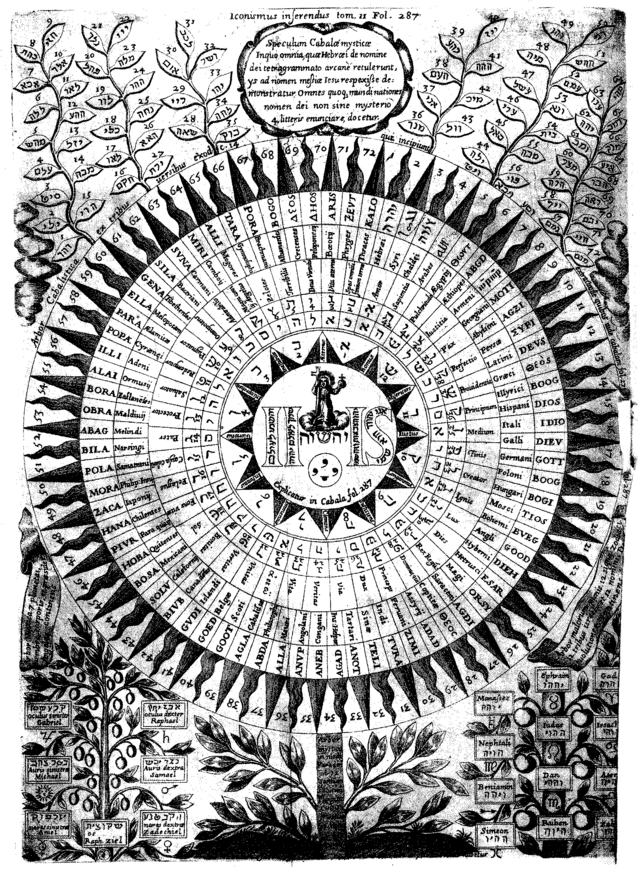
A diagram of the names of God in Athanasius Kircher’s Oedipus Aegyptiacus (1652–54). From Wikipedia.

Whether it’s apples or oceans, in signifying the larger thing, words behave like a sort of Google Maps – they’re a verbal bit of flatness to the reality of feeling the pebbles beneath the feet. We depend on the context and our shared experiences to fill the gaps much the way a Haiku poet does. We describe our world as best we can, and for the most part, it works.

While we’re chattering away, though, we have to remember that words aren’t the reality. Recent space exploration provides some interesting examples. Since the launch of the Hubble telescope in 2009, astronomers have adjusted calculations for the age of the universe to be in the neighborhood of 13.7 billion years old; the size of the universe being that large in light years. Our own galaxy is now estimated at about 100,000 light years across.  To talk about the scale of time and distance we use phrases like “light years” and words like “billions;” but how can we possibly comprehend the vastness signified by these casual phrases?

There’s absolutely nothing in our mortal experience to prepare us for the idea of a light year, nor light speed. As a result, it’s common for science writers to make comparisons for lay readers, like, “If the sun was the size of a beach ball, the earth would be the size of a pea 360 feet down the road, and the nearest other star would be over 18,000 miles away.”

Through the course of time, as humans evolved into the sapient creatures that we are, we’ve faced much that is beyond comprehension. Words and language evolve to help, and like any tool, enable people to navigate their reality. But here’s the kicker: these tools also limit – constrict – bind. In many cases, our thinking is circumscribed by the very tools we use to think.

Like a rock sticking up through the ground, words trip us up. In the Merriam-Webster Dictionary, the words spirit or being, or one are used to define God.  If we stopped and had a conversation on the topic with someone on the street, they might agree that those words are not quite enough for their idea. But like any sign, it has to be enough to think of the bigger thing being signified. We personify our god, and place her within the confines — if not an actual body, at least an embodiment. It’s like thinking about the size of Earth compared to Jupiter; let’s place this pea next to the pumpkin.

Herman Melville was describing this very situation when he wrote a letter to his neighbor Nathaniel Hawthorne,­­ “Take God out of the dictionary, and you would have Him in the street.” In other words, if you quit defining God, he can be alive and real.


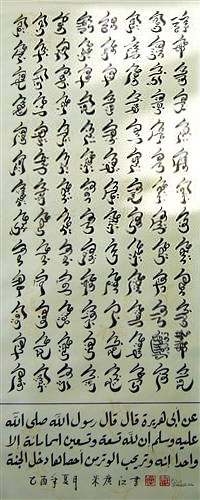
99 names of Allah, in Chinese Sini (script). From Wikipedia.

Our perceptual limitation may indeed be our language, or as others have suggested, perhaps it is our body. Yet much of the reality of the universe far exceeds this limitation. Sometimes, by defining something, we limit it to the breadth of our experience, we limit to the understanding of our body or language. The very origin of the word “define” means to conclude – to bring to an end. Is it any wonder that in countless mythologies that should a mere mortal actually see a divine being, that they’d be obliterated in the act? The dictionary states that God is a noun; but isn’t even the idea of noun restricting? Could God be noun, verb, adverb,  – all other parts of grammar, and even then some that haven’t been imagined?  Can we think about an ultimate driving force of the universe without putting it into grammar? In the Judaic tradition, scholars understood this and had many different names for their god – some with different grammar attributes, or even understood to be unpronounceable.

What would happen if, on a personal level, we removed the word? It’s possible that then, it would never be a matter of “believing in” or “not believing in,” of theism, or atheism, of your God and my God – but instead, simply an openness to the vast universe beyond words. We might then begin to dream of space and time that stretches in all directions infinite; the rhythms, the order, and even the chaos.

There is the moment in which we climb a mountain, sit down with a bottle of wine, and try to conceive of that ineffable something that begins where our bodies end. In the Buddhist traditions; this frontier is an illusion.  Even our thoughts are limits, and as the Buddhists suggest, our understanding will open when we learn the art of not getting “caught up” in thought. Not that thoughts don’t have meaning and purpose – but that attaching ourselves to them restrict.

In Zen Buddhism, there is a popular koan to the effect that if you meet the Buddha, you should kill him. Shunryu Suzuki wrote, “Kill the Buddha if the Buddha exists somewhere else. Kill the Buddha, because you should resume your own Buddha nature.” It’s easy to trip over these words, and take them literally; in Zen, these ideas are meant to trip up the logical mind; to force you to experience reality in a more fundamental way than that of the mind’s chatter and words.

Can we experience the essential force of the universe without resorting to the stringing together of letters and sounds? I imagine that we could, and that in doing so we would do so quietly, and that we would agree with Wittgenstein’s exhortation, “‘Make sure that your religion is a matter between you and God only.”

Boat House

That there are spring days in Central Park,
where the world rushes in, where
underworld choruses summon,
cinnamon dancers in the shadowed arches,
fountain splashes simple, easy laughter
the light touch of a seasoned busker’s
hammer dulcimer.

There are spring days in Central Park,
that span an imagined landscape where
unrestrained lovers didn’t envision
the inevitability of not loving, not feeling
that quickening of heart and breath from
just a simple touch.

There are spring days, even on the field of Issus
where bonebits of Darius’ startled army
plowed for centuries later or simply disintegrate
testament that a smaller force can prevail.

And passing the boat house, followed
by the eyes of a brother, the voice of a sister,
the immutability of a mother,
in parting what was not really together,
a weathered memory in sandstone.

Hero’s Journey and Relationships

Rilke once wrote, “For one human being to love another; that is perhaps the most difficult of all our tasks, the ultimate, the last test and proof, the work for which all other work is but preparation.” And while the poet loved his solitude and “terrible angels,” he took on the work of love with great passion, perhaps most notably with the psychoanalyst and writer, Lou Andreas Salome.

lou-andreas-and-nietzsche

Salome had a strong effect on many men of her time; and was probably what we’d today call a sapio-sexual. Nietzsche was utterly smitten with her, but his three proposals of marriage were rebuffed. The philosopher, in response, experienced a deep crisis, which after a phase of being debilitated, emerged and wrote his most powerful works. Perhaps, for Nietzsche, Salome was what writer Elizabeth Gilbert meant by the phrase soul mate, “A true soul mate is probably the most important person you’ll ever meet, because they tear down your walls and smack you awake. But to live with a soul mate forever? Nah. Too painful. Soul mates, they come into your life just to reveal another layer of yourself to you, and then leave. A soul mates purpose is to shake you up, tear apart your ego a little bit, show you your obstacles and addictions, break your heart open so new light can get in, make you so desperate and out of control that you have to transform your life…”

Certainly, Gilbert’s definition is far from universal. There is a great deal of discussion in the literature of romance and relationships regarding “the one,” or the “soulmate.” Many authors decry it as a harmful notion – while you’re waiting for that unique individual you miss the relationship that is right in front of you – the real blood and sweat person. The idea might just defy reasonable math, as one project [https://vimeo.com/111384864] demonstrates the logical fallacy – that depending upon where you live; your likelihood of finding that person will be reduced to irrational numbers.

Whether the notion of soul mate has validity or not; the juicy tidbit here is that the idea has such a strong hold on us. Is there one person out there for me? Do I hold out for a relationship that fulfills me on more levels – or do I accept a sort of self-imposed arranged marriage? Where’s the guidebook which we can scrub for the answers?

The Odyssey remains the greatest archetype of the hero’s journey of Western literature. It can also be read as blueprint of relationship archetypes. If we look to it for the idea of “the one,” it’s the wife of Odysseus, Penelope. She’s the mother from whom we break from in order to go about our hero’s journey – but then she is the one to whom we endeavor to return. As an archetype; don’t think that it’s the same flesh and blood individual; it’s a type.

There are other archetypes in the Odyssey, particularly those embodied in Calypso and Circe; both who play helper roles in Odysseus’s journey. They, more than Penelope, fit Gilbert’s definition and shake things up. Calypso provides the relationship that is nurturing and healing for Odysseus. But in some way (and Homer doesn’t go into detail) the relationship isn’t satisfying enough: Odysseus ruminates on Penelope more and more and longs to return to her. The gods intervene, and tell Calypso that she needs to release Odysseus, which she ultimately does; helping him to build a raft and sending him on his way.

calypso
Odysseus and Calypso. Red-figure vase. Clay. Paris, Louvre Museum

Like Calypso, the sorceress and demigoddess Circe also keeps Odysseus from his journey. First, she transforms his crew into animals; invoking a carnality of such a degree men metamorphise into animals. Odysseus would experience the same fate, but is forewarned, and through divine intervention knows to consume a prophylactic. Instead of becoming another barnyard inhabitant he becomes his host’s lover. As in the story of Calypso, the affair must end for the journey to continue. Circe is to remain, however, a woman that Odysseus feels strongly about, and in some later stories, returns to play an important role in the Odysseus story.

[footnote? In the Telegony, a now-lost epic poem that takes up where the Odyssey concludes, our hero’s journey continues. Circe returns to the story to, at the very least, bury Odysseus after he is accidentally killed by his son, Telegonus. [note; telegony is also the word used to describe the notion that a woman’s offspring can be affected by previous lovers – a belief that was once commonly given credence!]]

In the book Love’s Executioner a case study by the author, psychoanalyst Irvin D. Yalum, suggests another take on the whole soul mate belief; that perhaps, in wanting that “special person,” it means that we ourselves wish to be special.

“Specialness is the belief that one is invulnerable, inviolable – beyond the ordinary laws of human biology and destiny. At some point in life, each of us will face some crisis: it may be serious illness, career failure, or divorce (…) and challenges the common assumption that life will always be an eternal upward spiral.

Perhaps this is at the root of why the notion of that unique, special relationship has such a hold on the collective imagination; we each want to be unique and special. And in being so, somehow escape the inevitability of mortality. The soul mate paradigm is clear-cut; if we have such a relationship, we know it and power through whatever challenges it provides. A non-soul-mate paradigm is going to be messy. We’re not going to be sure what to do.

Lou Andreas Salome embraced the messy. Her marriage, itself, was celibate. She had multiple love affairs that lasted often for years. She might have been what has been adopted lately as “solo poly.” She did not subscribe to the notion of a single relationship and seemed to be open about it.

In the world of “solo poly,” practitioners refer to “escalator relationships,” meaning those relationships that take on the normal sequence of development: date, meet parents, move in together, get married, have children, etc. Salome certainly disdained that script.

Perhaps both Salome’s biography, as well as the Odyssey point to the different types of relationships we have – and “the one,” or “soulmate” are only one of the types. We might even encounter “the one” several times in our lives. We may also encounter many Circes and Calypsos. Or, we may find that at any given time, one person plays many roles for us. It’s messy; it’s uncertain. Even the best of guidebooks fail us.

Anaïs Nin talks about Lou Salome: