Big Doubt, Little Doubt

This post originally appeared at Successful-Blog, December 25, 2012

Beginnings are typically joyous, euphoric occasions. Whether it’€™s a software project, a barn-raising, a romance, or a painting, the earliest stages are exciting, not yet informed by the difficulties that lie ahead.

The art of making paintings is remarkable. It doesn’t€ matter if the painter is portraying mountains and streams, or is creating an abstraction. Taking the three-dimensional world and portraying it on a flat surface is abstraction, and creating shapes and color is quite concrete and real. So it follows that a lot of the distinctions that are made about painting, whether it’s realism, abstraction, or some other genre€“ are somewhat moot. But what all painting shares is that there is no guidebook. Each painter is on their own in trying to figure out what it is all about.

Over the years, I’€™ve noticed that I look forward to starting paintings. The canvas, newly tacked over the stretcher bars, presents a vast area of whiteness. A brush loaded with paint is picked up and that first mark is made. It’s exhilarating.

I also know what to expect about a third of the way into the painting: frustration. In those early years, it was unnerving: I’d be wracked with feelings of doubt and inability. Like an arctic explorer without a compass, I’d look around and realize that I didn’t have a clue as to where I was or why I was there. These aren’t the little niggling doubts that sometimes come to haunt us, but the big doubts. What does my existence mean?

For hundreds of years, practitioners of Zen Buddhism have been using doubt as a key to their practice. In the various approaches to Zen, the feeling of doubt is considered to be critical to finding awareness. In fact, koans, those baffling stories used in zen, seem designed to help bring about that total frustration. As one teacher exhorted, “let all of you become one mass of doubt and questioning.” Without this doubt, you can’€™t have breakthrough.

Self-doubt can be totally debilitating, too. If you understand, though, the importance of doubt in the creative process, you can more easily say to yourself, “heh, this is all part of the process; let’s just go with it.”

Old Houses

In each new home, I stood for some time in the basement, tracing
the copper pipes, the old cast iron waste,
the wires electric, even the old ceramic spindles.
I followed each joist to its seat, and sought out the origin of dust, perhaps
from powder post beetles or termites.
I sought out hollow spaces beneath the bluestone flags, hoping
to locate a hidden cistern, or treasure,
historic.
Once, the water feeds were so jammed with rust,
I had to hammer them free. I had to
learn humility and
the patience of plumbing.

Sometimes it was simply the light that fell
across a dining room floor, a built-in cupboard
with distorted glass,
or a back and narrow stairs. I love one
house, the antebellum slave quarters,
then filled with mouldering piles of pecans.
The house was a four over four, with uncanny dimensions.

Another was glorious with detritus, its original inhabitant
a famed suffragette, having left her dampened maroon Baedeker’s,
advertisements for the Hamburg-America. Cunard Line,
Lusitania deck-plans barely impeded the path, back
out the kitchen.

It was all, naturally, torn down.

Brachiopods

Reading Herodotus, or
driving through the Catskill range
past the oxidized effluvium of long-eroded mountains;
Past layers of catskills
delta, where subsequent glaciers scraped
at the Helderburgh sea, where
the orogeny of the acadian mountains gave way to
the Brachiopods of Mount Marion.

The Falls give way to the Resevoir, leaving
behind the cheap dinginess of a highwayside grocery, and
the piano hammer factory, where they
housed and loved old machines.

The indian trading post closed, but plaster
totems still stand in the woods, on the hill behind.

1/2

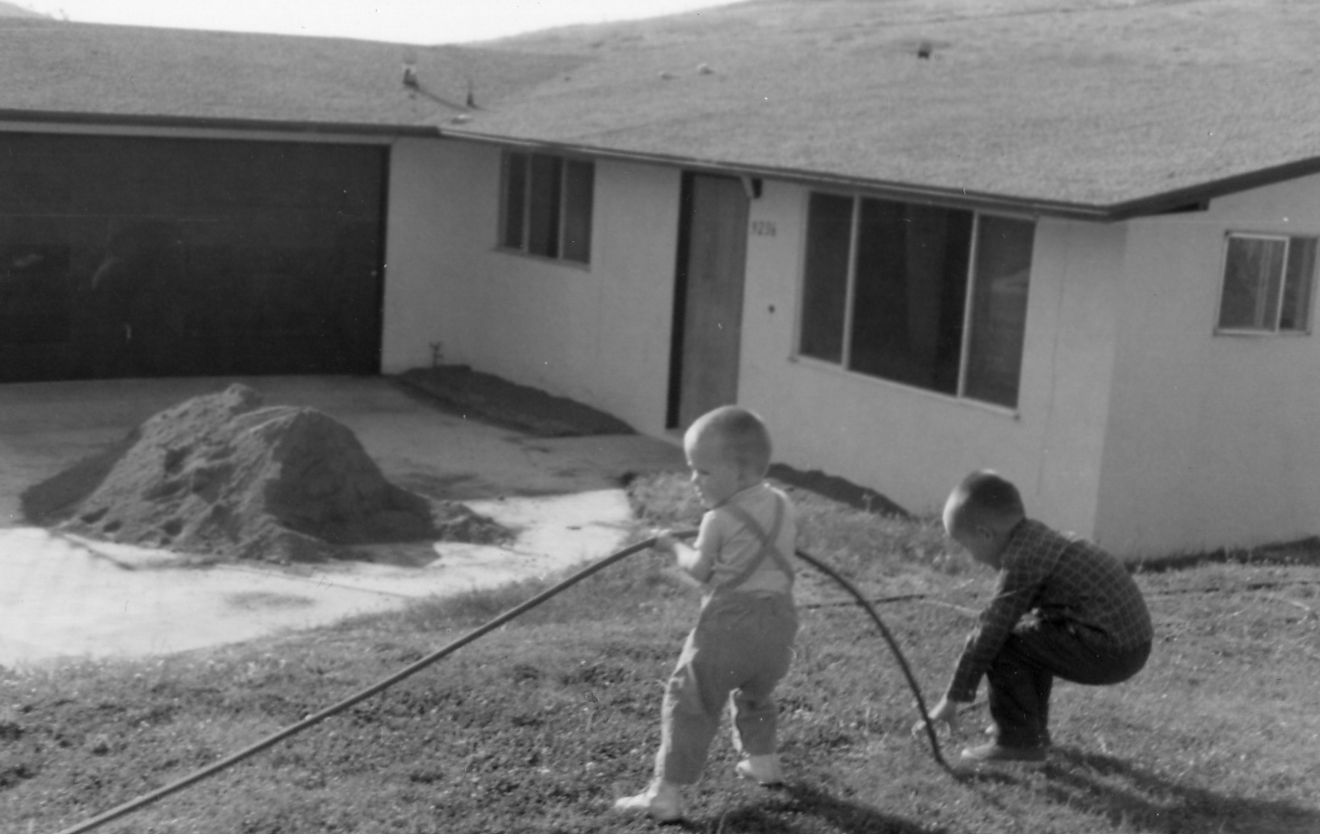
Our house was the first,
floating free of its footing,
moving away from the path leading
through the pasture where we would pass
the fly-swarmed dead horse,
fascinated.

I think I was fond of someone next door,
but I don’t remember.

Was it here that I first met
my father, home from Okinawa?
He had a magnificent flat-top crew cut.

They repaired our house.
But it was on the San Andreas Fault
and so other houses crawled,
or the cracks in bedroom walls
were so great the outside would be
more visible than proper,
and we all moved away.
When we returned, visiting,
the homes were used to shelter livestock.

1/1

That quiet lot across the road, where
comfort arms crossed, and
woolen-sweater-sheathed
the leapers, criers, the
many children are absent.
The wind gathers the leaves and bits of paper
re-mixes their movement and positing
folding and in-folding.

Galvanized chain link fences, rusted
along the bottom edge do
not so much as inhibit barrier-
crossers, but by deft defiance cause
the crisp light to leap up
into my arms, and running
back, so small, before the bricks and
faded advertising.

These palm lines converge too quickly,
they should encompass a greater expanse.

The lot, the empty lot, rolls downwards
towards the intersection, the lights going
through their motions, their sequences for hardly anyone.
And back across up to the teahouse
where a Paine’s grey watercolor sky reflects
from the top of a tepid cup, tightly held.

Bowling Alley

Do you ever have those dreams where you’re somewhere,
a bus station perhaps, and
turning the corner you’re in a bowling alley?

Someone nailed my feet. To the floor.
and my heart to I don’t know where, just that
there was a story being told,
a story that from an art-of-fiction perspective,
the dramatic tension, the character development,
was unresolved. And turning, looking,
into your face I was returned
home, opening the front door, back,
to a country, a field, a farm, I don’t know where, just
that it is the place from where I may have.

Fire Island

The freckles on your back are the stars of the milkyway,
My hand, the spaceship, slides down the
ridge of vertebrae, through the small,
across Orion’s belt to the doubleness
of your tush, tukas, ass, butt, derierre.
In these outer reaches of the galaxy
I lose my way – become disoriented.
These brownspots a map of Fire Island.

Artists’ Games

Originally published on Successful-Blog.com on July 9, 2012

The Games Artists Play

In his earlier days, the artist Chuck Close was a painter of gestural abstractions. After a personal crisis, he decided to take photographs, and square inch by square inch, make a large painting of the photograph. The process, to Close, was a game of sorts. If you get the opportunity to see one of his large scale paintings in a museum, the results are quite staggering.

Artists like to play games within their work. After all, there is no rule book on how to make a piece of art. Instead, you have total and absolute freedom. You can do anything you want – a freedom which can actually be paralyzing. Thus, by creating little games, the artist has a self-imposed framework in which to work.

My own game is to paint alla prima – which means at first attempt, and to paint all wet-into-wet; never onto dry paint. While I’ve found a way to keep my own paintings wet for weeks, and thus to sustain the game over a longer period of time, the historical idea of an alla prima painting, like those of the impressionists, was to create a painting in one sitting.

This is hardly a constraint taken on by all painters. In fact, Monet said something to the effect that you’re not worth your salt as a painter if you couldn’t put a painting away for a couple of months, come back to it, and not see what it needed. Bonnard was said to sneak into museums with a brush and colors under his coat to touch up his own paintings.

How Artists’ Games Can Help Our Work

Reworking a piece over a long period of time can certainly bring richness to any work. It’s over time that we are able to reinforce subtle patterns, or refine smaller ideas within the larger piece. But sometimes, it’s difficult to let go of a piece. Our anxiety about getting it right takes over.

The idea, though, of saying that a painting, or even a piece of writing, is going to be done in one period of time – that I’ll do the best I can NOW, and that I’ll do this and move on to the next – can mitigate compulsiveness. We can bring this idea to writing too – I’ll write a piece – but after I’m done, I’m done. No going back and improving. Blogging is ideal for this – after all, changing a post after it’s been published, and after people have participated in the piece by commenting just doesn’t feel right.

If you find yourself stuck in your endeavors, and unable to break through some invisible barrier, try creating your own parameters and games. After all, it’s your game, and there’s not a person in the world who can say that it’s wrong.

Admire! Admire! Admire!

A version of this post first appeared in Successful-Blog.com, June 2012

At first, when people are studying to become visual artists they work very hard at getting their hands to respond accurately to what they see. Over time there is a shift as the artist chooses to emphasize, edit, and curate – they tend to bring focus to what they love and admire and tend to gloss over that which they do not like.

They might admire the horrible and the ugly. A steady diet of prettiness and even beauty can be tedious. Sometimes a scar, a blemish, an imperfection enhances what we love.  Sometimes we are more interested in what shocks us out of our stupor, and makes us feel more alive.

Even photographers choose to click the camera at some moments, pointing in some directions, while not doing so at other moments, and in other directions. They choose what to photograph.

Van Gogh wrote to his brother, Theo, “Admire, Admire, Admire – the only path to growth.”  When he wrote that, Vincent was living with destitute coal miners in an extreme wretched state of poverty. Yet in that environment, that which he chose to sing from the mountaintops was “admire.”

In admiring, we forgive what we don’t like.

To be forgiving is to be flexible.  You give way.  You are charitable. Otherwise, you are rigid, and unforgiving.  Uncharitable.

Being charitable doesn’t just mean giving money to your favorite cause.  It means that you don’t assume that what motivates others isn’t opposed to you.

These are some of the big words of morality: charity, mercy, forgiveness, admiration, love. The German philosopher, Friedrich Nietzsche, exhorted us to re-evaluate our morals – to not simply accept the morals handed down to us by our families, churches, governments, and pop songs.  When we really examine the idea that we should focus on what we admire, and in the process, practice these big morals, we do ourselves a great service.

Imagine walking down a street.  You see a beautiful 19th century doorway, a knocker, perhaps a door knob. You see a beautiful chimney.  Meanwhile, you might pass by some piles of dog crap. You can choose to focus on the crap, or you can focus on what you admire.  There is choice there.  

There is ugliness all around us. You can search it out, and you will certainly find it. Isn’t it more gratifying to search out and take note of what you admire?

There is a time to stand up against something that isn’t right. I’m not saying that we should always smile and nod our heads.  Great evils have been perpetrated in this world simply because no one spoke out when needed. But there is a difference between speaking up when something really wrong is happening, and making a habit of taking note of what we don’t love.

There is a time to be critical. We don’t want a world where everything is unicorn sparkles and Kumbaya. Not being critical doesn’t mean that everything should be saccharine. But when an editor works through a manuscript, it is finite – it has boundaries. Our lives, on the other hand, are only delimited by the limits of our perception. There is a time to search out what is wrong or faulty in something – but if that is the way of our everyday life, we communicate wrongness in everything we do.

In dealing with employees or our families, if we focus on what is wrong, and what needs to be fixed, we are communicating the assumption of being broken. When people receive that message all of the time, they assume it as their story, and as the truth.  We are all in the business of telling stories – and in telling our stories, we will not help our heroes fulfill their destinies by teaching them that they are fundamentally broken and need to be fixed.

I’ve recently taken a lot of plane trips. Each time I’m in a plane taking off, first, I’m still amazed that a huge container made out of metal can fly us at amazing speeds and heights to our destinations. Then, I am usually amazed at the sheer quantity of people down there: all of those little houses, and cars – such an incredible density of people all across the country.

It’s easy to imagine that within all of this density that the behaviors of one individual could easily spread out to others.

My friend Liz Strauss says that we don’t see the most important thing about Twitter – that it’s the LARGEST NETWORKING GROUP in the WORLD.  We exist, in social media, in a density that is even greater than that of people living in New York City or Tokyo.

There has been a tendency in social media for people to get snarky, and critical. Someone says something stupid, we get angry or critical, and we spread that anger and criticality. It’s as though we were walking down that street and making note of all the garbage and dog crap in our path. We’re not seeing the beautiful door knobs.

Sometimes, you tell a child something, and you don’t think they’ve heard you – then, a few days later, you hear them telling another child just what you were telling them. We never really know just how influential we are. Sometimes, we learn from people many years later that we were a powerful force in their life.

It is in your power to, like a painter, focus on what you admire, and share that admiring viewpoint. It is in your power to focus on what you love, and change the narrative that others are telling themselves.  It’s in your power to be forgiving of that which you dislike, and help the heroes around you in their journeys.

Admire, admire, admire!